Concealed Carry Methods: Matching Holster, Clothing, and Firearm

One of the hardest parts of everyday concealed carry is not the decision to carry. It is choosing how to carry so the gun stays secure, accessible, and actually hidden in the clothes you wear.
A full-size 1911, a compact 9mm, a .380, and a true vest-pocket pistol do not behave the same way. Neither do a tucked dress shirt, a jacket, jeans, or athletic shorts. The “best” method is the one you will wear consistently, draw from safely, and keep concealed without constant adjustment.
Below is a practical look at the main options: pocket carry, shoulder holster, IWB, and OWB. Laws, permit rules, and “brandishing” standards vary by location. Train with whatever method you choose.
Pocket carry
Best suited for: Very small pistols (.380, .32, true pocket guns). Sometimes a slim single-stack 9mm in a dedicated pocket holster.
Benefits
- Fast to add or remove. No belt required.
- Works with shorts, sweats, and casual clothes that fight IWB.
- Low visual profile if the pocket is deep and the holster breaks up the outline.
- Comfortable for many people who cannot tolerate a belt holster all day.
Drawbacks
- Limited to small, light guns. A 1911 or duty-size 9mm will print, sag, or become unsafe.
- Draw can be slower and less consistent, especially seated or with a tight pocket.
- Pocket lint, keys, and other objects become a safety problem unless the gun is in a dedicated pocket holster that covers the trigger.
- Deep concealment often means a slower first shot and a weaker firing grip on the draw.
- Not ideal if you sit a lot or keep a phone in the same pocket.
Rule of thumb: If the gun is not made for a pocket, do not force it into one.
Shoulder holster
Best suited for: Larger pistols under a jacket, vest, or coat. Some people use it for 1911s and compact/full-size 9mms when a covering garment is always on.
Benefits
- Takes weight off the belt and lower back.
- Can conceal a larger frame under a blazer, field coat, or overshirt.
- Comfortable for driving or sitting if the harness is set up well.
- Useful when belts, IWB clips, or medical issues make waist carry painful.
Drawbacks
- Almost always requires a covering garment. Without one, it is open carry.
- Draw crosses the body; muzzle direction during the draw needs serious training.
- Harness can print at the shoulder or under the opposite arm.
- Slower than a well-practiced IWB draw for many people.
- Can be hot, and straps shift if not fitted.
- Some ranges and classes restrict or dislike the muzzle sweep inherent in the draw.
Rule of thumb: Treat this as a jacket-dependent system, not an all-day T-shirt system.
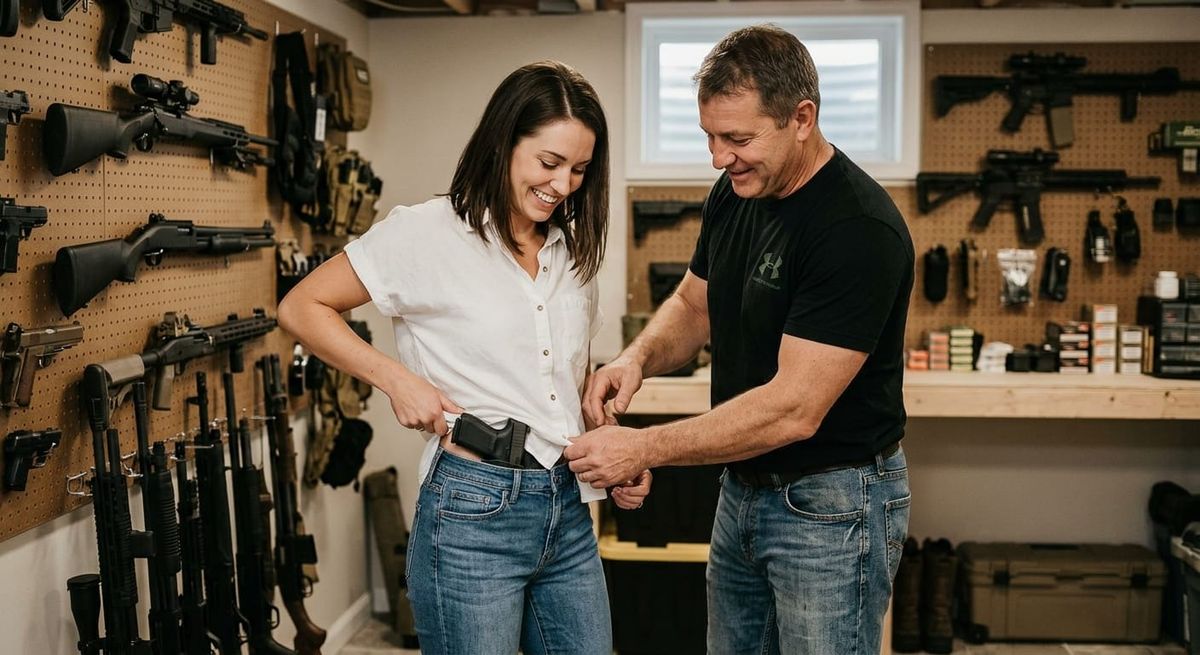
IWB (inside the waistband)
This is the default for a lot of modern concealed carry. Position matters as much as the holster.
Appendix / front (roughly 12–2 o’clock)
Benefits: Fast draw, easy to protect the gun in a crowd, works well with compact and some mid-size 9mms. Easier to see and control during the draw.
Drawbacks: Less comfortable seated or bent over for many people. Requires a good holster with solid trigger coverage and careful reholstering. Not ideal for some body types or larger frames like a full-size 1911.
Strong-side hip / behind the hip (3–5 o’clock)
Benefits: Classic, proven, often more comfortable for all-day wear. Hides compact and many full-size guns under an untucked shirt. Good for 1911s if the holster and belt are right.
Drawbacks: Slower draw than appendix for many. Harder to protect in a close grapple. Prints more easily if the shirt is tight or you reach overhead. Reaching the gun while seated in a car can be awkward.
IWB overall benefits
- Best concealment-to-access balance for many compact and mid-size pistols.
- Works with an untucked shirt, light jacket, or overshirt.
- Wide holster market (Kydex, hybrid, leather).
IWB overall drawbacks
- Needs a proper gun belt. A dress belt will sag and print.
- Comfort depends heavily on holster design, cant, ride height, and your body.
- Warm-weather clothing can make concealment harder.
- Full-size 1911s are carryable IWB for some people, miserable for others.
OWB (outside the waistband), concealed
OWB is often thought of as open carry. Concealed OWB means a covering garment: jacket, untucked overshirt, vest, or coat.
Strong-side hip
Benefits: Usually the most comfortable way to carry a full-size 1911 or duty-size 9mm. Easier draw than IWB. Less sweat against the body. Excellent for range and field use that still needs to go covered in public.
Drawbacks: Needs more garment than IWB. Prints if the covering layer is too short or too tight. Can bump chairs, car seats, and door frames. Harder to conceal in summer.
Small-of-back / rear OWB
Benefits: Can hide a larger gun under a long shirt or jacket.
Drawbacks: Dangerous fall risk (spine), slower and more awkward draw, poor weapon retention, miserable while seated. Generally a poor choice for everyday concealed carry.
Rule of thumb: Concealed OWB works when your clothing plan always includes a covering layer. It fails the first hot day you take the jacket off.
How clothing and gun size drive the choice
| Firearm | Often works well | Often fights you |
|---|---|---|
| Vest-pocket / tiny .380 | Pocket holster, deep IWB | OWB, shoulder (overkill and harder to hide the harness) |
| Slim .380 / small 9mm | Pocket (sometimes), IWB appendix or 3–4 o’clock | Heavy OWB unless you want extra bulk |
| Compact 9mm | IWB (appendix or hip), concealed OWB with jacket | Pocket (usually too big) |
| Full-size 1911 / duty 9mm | Quality IWB on a real belt, concealed OWB, shoulder under a coat | Pocket, most athletic shorts, tight T-shirts |
Clothing rules of thumb:
- Tucked dress shirt: IWB with a tuckable holster, or a jacket plus shoulder/OWB.
- Untucked button-up or overshirt: IWB or concealed OWB.
- T-shirt and jeans: compact IWB is usually the path of least resistance.
- Shorts / no belt: pocket gun or a purpose-built carry system—not a 1911.
- Coat season: shoulder or OWB suddenly become realistic for larger pistols.
Test concealment and the draw at home
Testing is not optional. Under stress you will not rise to the occasion. You will default to the level of your training and to whatever your hands have actually done with this gun, this holster, and these clothes.
Do this at home with an unloaded firearm. Confirm empty chamber and magazine, then check again. No live ammunition in the room during dry practice.
Concealment checks
- Stand in front of a mirror in the exact clothes you plan to wear.
- Look from the front, side, and rear. Raise your arms. Bend to tie a shoe. Sit down. Reach for a high shelf. Get in and out of a chair or car seat.
- Walk, climb stairs, and put on a coat. If the outline appears, the holster rides too high, the belt is too soft, or the garment is too tight.
- Have a trusted person look without you telling them where the gun is. If they spot it immediately, so will everyone else.
Draw and reholster practice
- Practice clearing the covering garment the same way every time.
- Establish a full firing grip in the holster before the gun leaves it.
- Draw to a ready position, then reholster slowly and deliberately. Most negligent discharges happen on the way back in.
- Repeat standing, seated, and from a jacket or overshirt if that is how you actually dress.
- Practice weak-hand garment clearing if your strong hand may be occupied.
- Start slow. Speed comes after the motion is clean. Fast and sloppy is how people sweep themselves or snag clothing in the trigger guard.
A setup that looks fine in the closet and fails when you sit, bend, or draw is not a carry system. It is a costume. Test until concealment holds and the draw is boringly repeatable.
What matters more than the “best” holster
- A holster that fully covers the trigger.
- A belt or support system that does not collapse.
- A draw you have practiced from concealment, including seated and from a coat.
- Consistent concealment. A method you abandon after two hours is not a method.
- Reholstering discipline.
Community question
What combination actually survives a full day for you, your gun, holster position, and clothing—without constant adjusting? A compact 9mm at 3 o’clock under an untucked shirt is a different world from a 1911 under a jacket or a .380 in a pocket holster. The useful answers are the ones people still use after six months, not the ones that look perfect in a mirror for five minutes.
Train, check local law, and choose the setup you will actually wear.
Disclaimer
This post is for general discussion and education only. It is not legal advice, firearms training, or a recommendation to carry any particular firearm or holster. Concealed-carry laws, permit requirements, prohibited locations, and use-of-force rules vary by state and locality. Always follow applicable law. Use a quality holster that covers the trigger, confirm the firearm is unloaded before any home practice, and seek qualified, in-person instruction. You are responsible for your own safety, storage, and decision-making.