A kit without a mission is just a heavy bag.

This is the second post in the AFR 64-4 series. Chapter 16 was fire. Chapter 17 is equipment — what you carry, how you keep it working, and what you do when the issued bag is gone.
Section 17-1 opens the way a good kit should open. Survivors have needs. Food. Water. Clothing. Shelter. The kit exists to meet those needs. Then the manual says the quiet part out loud. Quite often this equipment may not be available due to damage or loss.
That sentence is why a small pack exists. Not because it looks ready on a tailgate. Because you can be cut off from camp, cabin, vehicle, or the main cache and still have a job to do.
What Chapter 17 actually says
17-2 — Two kinds of kit, not one magic bag
Issued survival kits split into mandatory and optional.
Mandatory in the aircrew kit of 1985 meant a raft, a compass, flares, a signal mirror, first aid, a survival radio. Those items answer a specific mission: stay alive and get found.
Optional items are chosen for climate and terrain — a sleeping bag, a strobe, a wire saw, a water container, a shovel, a match safe. Command picks them because the ground changes. That is the rule. The bag follows the mission and the country you are standing on, not a shopping list copied from the internet.
A go bag with no mission is the opposite of 17-2. It is optional gear with no climate, no terrain, and no task.
17-3 — Issued gear only works if you treat it like issued gear
The chapter spends real space on care, not on buying more.
- Electronics. Keep signaling gear warm in the cold so the batteries do not cold-soak. Do not talk wet breath straight into a microphone in freezing weather. Do not press a frozen radio against skin. Keep it dry when you can. In open water you may only get to shake the mic and transmit.
- Firearms. A firearm is a precision tool. Salt, sweat, dew, and humidity will take it offline. If it goes in salt water: fresh-water rinse, dry, oil. Boiling water and residual heat can dry it. Uncontrolled heat over about 250°F can ruin springs. In hard cold, petroleum lube can stiffen or freeze — clean it and run it dry rather than gum the action. Metal gets brittle in the cold. Do not use the gun as a club, a hammer, or a pry bar.
- Cutting tools. A sharp tool is a safe tool. Stone the knife. Save the file for axes, and for taking plating off a blade. Cut with control. Whittling in this chapter is not a camp pastime. It is how you make trap triggers, spacers, and the small parts you did not pack. Cut away from the body. Cut with the grain.
Later in the same chapter the manual makes the point we already used with fire. Even with a survival kit on paper, aircrew were told to carry a personal kit on the body. People have hit the ground running and left the issued bag behind.
The small pack is that idea. It is not the camp. It is what is still on you when the camp is not.
Make the kit match the mission
My basic small pack is built for one job. I am away from the main supplies — camp, cabin, or vehicle — and I still need to move, eat, signal, and stay quiet enough not to advertise where I am.
That is not an everyday-carry list. EDC stays EDC. The small pack is the separation kit.
Why the Henry Survival AR-7
Chapter 17 treats the firearm as a tool you keep working in wet and cold, not as a totem. The Henry Survival AR-7 earns its slot for reasons the manual would recognize.
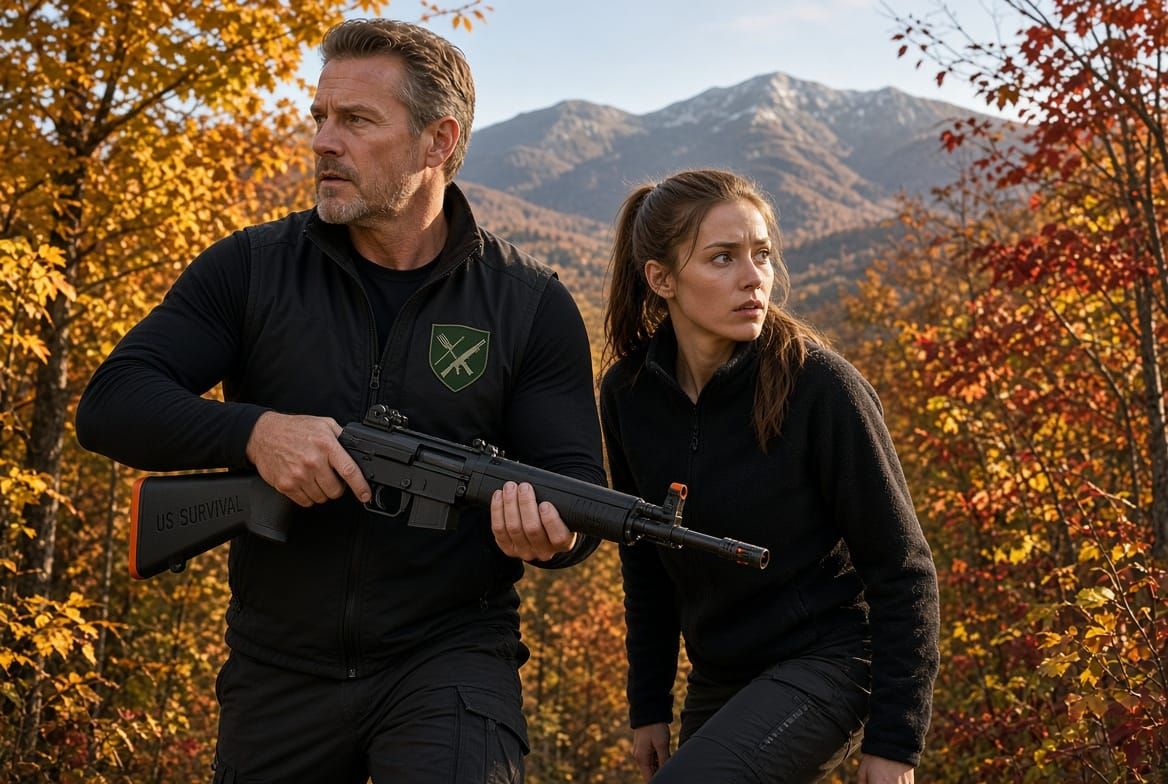
It breaks down and stores in its own sealed, watertight stock. That is little pack volume and a rifle you can still put together with cold hands. That stock is built to float. If the pack goes in the drink, the rifle is designed to stay with you and stay dry inside. And it feeds .22 LR. Ammunition weight is the hidden tax on every other item in the bag. You can carry a useful count without crowding out water, tinder, and a knife.
It is not a battle rifle. It is a survival rifle. Small game. A tool that survives a dunking. A host for a can. That matches 17-3. Care still applies. Dry it. Oil it when the climate calls for oil. Keep it out of the salt. Do not pry with it.
Why the Beretta .22 LR pocket pistol next to it
Same cartridge. Same weight logic. The small Beretta does not replace the Henry. It covers the minutes the rifle is still in the stock or still in the pack — one hand occupied, tight cover, a gun you can put into play without assembling the AR-7 first.
Two guns. One ammunition family. That is kit discipline. You are not carrying a second logistics problem.
Why .22 LR for this pack
.22 LR is the point of the pair.
- Weight. Rimfire stacks in a small pack. Centerfire survival loads pay a space-and-pound tax this kit cannot afford.
- Small game. That is the food job. Squirrel, rabbit, birds where legal. The Henry and the Beretta both do that work.
- Penetration, load by load. Bulk-pack .22 LR often stops short of the FBI’s 12-to-18-inch window in 10 percent gel. However, modern defensive loads are a different animal. Federal Punch — a 29-grain nickel-jacketed flat point made for short barrels — was designed to reach that 12-inch floor. Federal’s own gel work put it around 13.75 inches. Independent tests have shown similar numbers from pocket pistols, including a Beretta 21. CCI Stinger has cleared 12 inches in some published gel tests as well. That is not the same as saying every .22 in the pack is a duty round, and it is not the full FBI barrier suite of steel, wallboard, and windshield. It does mean you can choose a load that meets the minimum penetration standard instead of guessing with range ammo.
- Signature. Unsuppressed, .22 LR is already a smaller report than almost anything else people throw in a bag. With a suppressor on either host it is quiet enough that you are not painting a grid square for everyone in the drainage. In a real problem you may be evading people who are hunting you, or simply sharing woods with people you do not want to call.
Why they share a suppressor
Chapter 16 already told you fire and smoke can mark you. Sound does the same thing.
One can. Two hosts. Same cartridge. Take the shot you must take — game, or a problem you cannot walk away from — without writing your name in the air. Train the swap on the Henry Survival AR-7 and the Beretta until it is boring. A shared can you cannot mount under stress is theater.
What the small pack is for — and what it is not
It is for separation. Lost on a cut trail. Pushed off a fishing spot. A day hike that becomes a night. You are not opening the cabin locker. You have what is on your back and on your belt.
It is not the homestead loadout. It is not the truck gun. It is not every caliber you like. If an item does not serve food, water, shelter, fire, movement, signaling, or quiet work in this country, it stays home.
Layer it the way 17-2 layers issued kits:
- On the body: knife — the Mora from the fire post — ferro rod and striker, compass, fire-making that does not depend on a lighter, a way to carry water, a way to signal.
- In the small pack: the Henry Survival AR-7, the Beretta .22, the shared can, enough .22 LR to matter, first aid, a little food, and a way to repair and dry the tools Chapter 17 says will fail if you neglect them.
- In camp / cabin / vehicle: the heavy optional list. Shelter. Extra food. Tools. The gear you cannot afford to swim with.
If the small pack is trying to be all three layers, it will be too heavy to grab when you actually separate.
Care is part of the kit
17-3 is the maintenance chapter hiding inside the gear chapter. Put it on a card in the pack:
- After wet: rinse if it was salt, then dry, then oil.
- In hard cold: clean the lube out of the guns if it will freeze. Keep electronics inside the clothing layer.
- Stone the knife. Do not file the Mora to death.
- The suppressor is a precision tube. Treat it like the firearm — water, carbon, and thread care — or it becomes a paperweight you carried for nothing.
A kit you never clean is already lost. The manual said that in 1985 with different radios and different steel. The rule did not change.
Practice that matches the mission
Same standard as the fire post. Do not only read Chapter 17.
On the next outing where you leave camp:
- Leave the main stores in camp. Take the small pack only.
- Build the fire the Chapter 16 way. No lighter. No canister stove.
- Carry the AR-7 wet-and-dry drill in your head. If this pack went in the drink, what still works?
- Mount and dismount the shared can on the Henry Survival AR-7 and the Beretta until the swap is boring.
- Cook and move on what that pack holds. If you keep reaching for the stuff in the truck, the pack is not a kit yet.
If the bag only makes sense on the tailgate, it does not make sense.
Read the source. Put it in the Ready Center.
AFR 64-4 Vol I, Chapter 17 — Equipment.
https://archive.org/details/USAirForceSurvivalSchoolAFRegulation644.11985
https://archive.org/details/Afr64-4352-481Survivalmanual
Ask for the community: file Chapter 17 next to Chapter 16 in the Ready Center library. Add a one-page local kit card — mission, terrain, on-body / small pack / camp — and a care line for wet and cold. A printed packing list with no mission statement does not belong in the folder.
Fire without fuel is a spark. A bag without a mission is weight. Build both on purpose.