After the Range: Minimal Handgun Cleaning (No Full Breakdown Required)

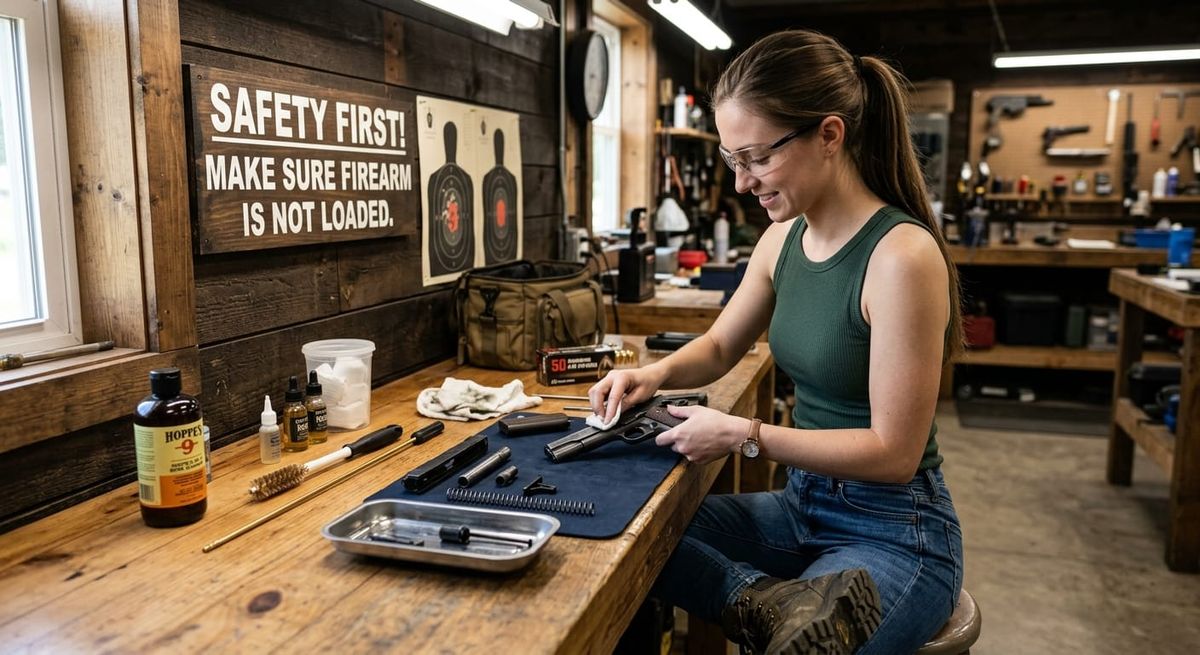
You do not need a gunsmith-level teardown after every range trip. You do need a safe, repeatable field clean so residue and grit are not stored against metal for weeks.
This guide covers three common handgun types:
- Semi-automatic pistol
- Revolver
- Single-shot break-open pistol
Each section uses the same safety rules and a minimal kit. Adjust depth if you shot a lot, used corrosive ammo, ran a suppressor, or got sand/mud in the gun.
Safety first (every type)
Do this before any cloth or brush touches the gun:
- Muzzle in a safe direction
- Finger off the trigger
- Unload completely
- Verify empty — eyes and finger: magazine out (if applicable), chamber(s) empty
- No ammunition in the cleaning area
- Eye protection if you are brushing firmly
If you are tired, rushed, or distracted, wait. Most cleaning accidents happen when someone “knows” the gun is empty.
Minimal kit
- Clean cloths / patches
- CLP, or separate cleaner + light oil
- Nylon brush or a toothbrush used only for firearms
- Cotton swabs
- Bore snake or rod + jag/patches (for barrels)
- Optional: disposable gloves (indoor ranges and lead dust)
Work over a mat. Keep solvent off grips, wood, and optics unless the product is rated for them.
1. Semi-automatic pistol
Typical examples: striker-fired or hammer-fired service and carry pistols.
What you are cleaning for
Powder residue and carbon collect on the slide, around the ejection port, near the chamber, and on the feed ramp area. Rails need a thin film of lubrication—not a bath.
Checklist (no full detail strip)
| Step | Action | Why |
|---|---|---|
| 1 | Confirm clear: mag out, slide locked back, chamber empty | Non-negotiable |
| 2 | Wipe exterior: slide, frame, controls, dust cover | Removes grit before it works into rails |
| 3 | Bore: several passes with snake or patches + cleaner until acceptable | Fouling from this session, not a mirror bore |
| 4 | Chamber mouth / ejection port: swab visible carbon | Common short-term reliability area |
| 5 | Feed ramp (visible): gentle wipe | Helps next rounds feed cleanly |
| 6 | Rails: wipe accessible rail surfaces; apply a thin oil film | Metal-on-metal needs lube; excess oil holds dirt |
| 7 | Recoil spring area (visible only): wipe what you can without a full strip | Carbon builds here on high-round days |
| 8 | Magazine bodies: wipe outside; dump debris from mag well area of the gun | Dirty mags cause “gun” problems |
| 9 | Unloaded function check: slide cycles, controls feel normal | Catch binding before storage |
| 10 | Light exterior wipe of fingerprints on steel if you care about finish | Humidity and skin oils |
Stop here for a normal range session. Schedule a deeper clean if the gun was filthy, wet, or unusually high round count.
2. Revolver
Typical examples: double-action or single-action wheel guns.
What you are cleaning for
Revolvers push residue into the forcing cone, cylinder face, charge holes (chambers), under the extractor (on many DA revolvers), and around the crane/yoke. Leading and powder under the extractor star are classic causes of a cylinder that is hard to turn.
Checklist (no full side-plate removal)
| Step | Action | Why |
|---|---|---|
| 1 | Confirm clear: all charge holes empty; visually check each | Multiple chambers = multiple places to miss |
| 2 | Wipe exterior: barrel, frame, cylinder, yoke area | Surface grit and burnt powder |
| 3 | Cylinder face and forcing cone gap area: cloth + light cleaner | Heavy deposit zone on revolvers |
| 4 | Each charge hole: brush or swab, then patches | Fouling here affects extraction and seating |
| 5 | Bore: snake or rod + patches | Same as any barrel |
| 6 | Under extractor star (if your model allows careful access): soft brush / swab—do not pry aggressively | Grit under the star binds rotation |
| 7 | Crane/yoke area: wipe visible pivot and under-cylinder surfaces | Sticky cylinder feel often starts here |
| 8 | Very light oil on crane pivot and a thin film where the cylinder aligns—wipe excess | Smooth rotation; avoid oil in charge holes |
| 9 | Unloaded function: cylinder rotates freely; latch locks cleanly | Binding now means residue still present |
| 10 | Wipe grips and exterior for storage | Clean handling surfaces |
Do not flood the action with solvent through the hammer/trigger slot as a shortcut. That washes residue into places you cannot wipe without a real detail clean.
3. Single-shot break-open pistol
Typical examples: break-action single shots, some specialty and hunting-style pistols.
What you are cleaning for
Simple actions still foul the bore, chamber, and hinge/latch surfaces. The face of the breech and the barrel flats collect residue where the gun locks up.
Checklist (no unnecessary disassembly)
| Step | Action | Why |
|---|---|---|
| 1 | Confirm clear: action open, chamber empty | Easy to verify—still do it every time |
| 2 | Wipe exterior and barrel exterior | Grit and burned powder |
| 3 | Chamber and breech face: swab until residue is gone | Sealing and extraction surfaces |
| 4 | Bore: patches or snake with cleaner, then dry patches | Accuracy and corrosion control |
| 5 | Hinge / pivot and latch surfaces: wipe; thin oil on metal pivot points only | Keeps break-open smooth; excess oil attracts grit |
| 6 | Extractor/ejector area (visible): clean carbon | Sticky extraction after dirty sessions |
| 7 | Close and open unloaded: latch engages positively | Confirms nothing is gummed up |
| 8 | Final dry wipe of chamber before storage | No solvent left to pool |
If the gun has fixed sights or a scope, keep chemicals off lenses and avoid soaking wood stocks.
Range cleaning room vs home
| Range room | Home | |
|---|---|---|
| Priority | Safe clear, exterior, quick bore, bag it clean | Same + a bit more time on chambers/rails |
| Pressure | People waiting—do not skip the empty check | Still no ammo on the table |
| Depth | Minimal is enough for transport | Minimal is still enough for most sessions |
| Waste | Follow range rules for patches and solvent | Bag dirty patches; wash hands |
When minimal is not enough
Plan a deeper clean soon if:
- Corrosive or very dirty ammo was used
- The gun was dropped in sand, mud, or snow
- The cylinder binds or the slide feels gritty after the field clean
- You are putting the gun away for a long storage period in humidity
Minimal clean is maintenance between deeper cleans, not a substitute for periodic thorough work.
Optional habit that pays off
After you clean, jot down:
- Date
- Firearm
- Approximate rounds fired
- Ammo type
- “Light clean / bore + lube” (or whatever you did)
That history answers “when did I last run this hard?” and supports smarter deeper-clean timing. Inventory and maintenance trackers can store those notes; a small notebook works too. The checklist is the discipline—the log is the memory.
If you think we missed something feel free to leave it in the comments.