How Criminals Choose Targets—and How Situational Awareness Makes You a Harder One

Most people think of personal safety as something that starts when trouble is already happening. In reality, a large part of risk is decided earlier—when someone decides whether you look like an easy opportunity.
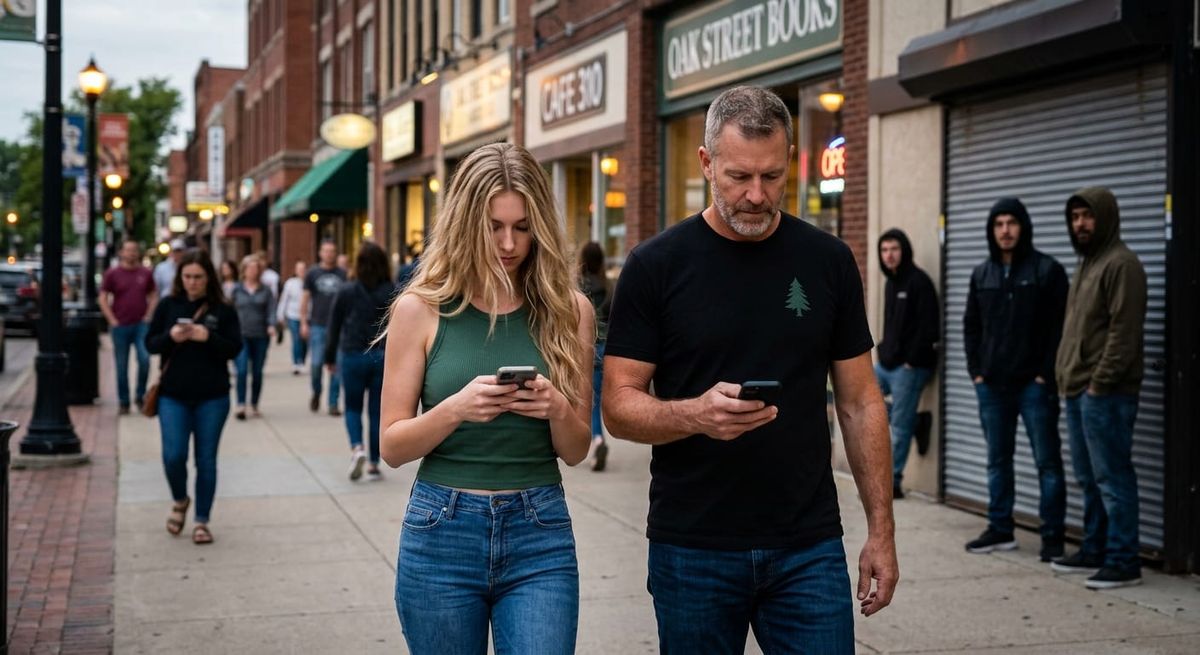
Research and law-enforcement experience have long pointed to the same pattern: attackers and robbers often select victims based on appearance of awareness, body language, isolation, and predictability. Gait, posture, phone use, and whether you notice your surroundings all factor into that split-second assessment.
You cannot control every threat. You can control how readable and reachable you are.
This post explains how that selection process works, how the OODA Loop applies to everyday safety, and how to build practical situational awareness—without living in fear. It also explains why fitness and physical preparedness are not vanity side topics: they change how you look, how you move, and how many options you still have if something goes wrong.
Why some people get chosen
Criminals looking for a quick win generally prefer targets who are:
- Distracted (phone, headphones, arguments)
- Isolated (empty lots, quiet paths, late transit)
- Uncertain (lost, hesitating, looking down)
- Overloaded (hands full, struggling with bags or kids and gear)
- Predictable (same route, same habits, same exit every time)
Confident, attentive movement does not make you invincible. It does make you a poorer return on risk. Many offenders will pass on a hard target and wait for an easier one.
That is the core idea behind everyday awareness: raise the cost of choosing you.
The OODA Loop: a simple model for staying ahead
The OODA Loop was developed by military strategist Colonel John Boyd. It describes how people and organizations succeed under pressure:
Observe → Orient → Decide → Act
Then the loop repeats.
In a street or parking-lot context, it looks like this:
1. Observe
Take in raw information: people, exits, lighting, distance, sound, movement.
- Who is near me?
- Is anyone matching my pace?
- Are there bottlenecks, dark corners, or blocked exits?
- What changed since I last looked?
Observation is not staring. It is periodic, deliberate scanning.
2. Orient
This is the most important—and most neglected—step. Orientation is how you interpret what you see using experience, context, and expectations.
Examples:
- A person walking the same direction may be normal… or may be closing distance.
- A van with the side door open near your car might be a delivery… or a problem.
- Your discomfort in a stairwell might be fatigue… or valid intuition.
Orientation answers: What does this mean for me, right now?
Stress, fatigue, alcohol, and phone fixation all degrade orientation. Training improves it.
3. Decide
Choose a response while you still have options:
- Cross the street
- Enter an open business
- Put the phone away
- Change direction
- Call someone and narrate your location
- Return to a populated area
Early decisions are usually cheap. Late decisions are expensive.
4. Act
Execute the decision cleanly. Then return to Observe.
People who freeze are often stuck between Orient and Decide. People who panic often Act without Orienting. Good awareness keeps the loop moving at a sustainable pace.
Key insight: Attackers run an OODA loop too. If you observe and orient faster than they expect, their plan loses tempo. You become inconvenient.
Situational awareness in practice
Use layers, not tunnel vision
Scan in three bands:
- Immediate — arm’s reach and your next few steps
- Near — roughly conversational distance to a short sprint
- Far — end of the block, lot entrances, lighting, exits
Every few seconds, let your eyes complete a small circuit. Then return to normal activity. This is sustainable; hypervigilance is not.
Posture and gait matter
You do not need a “tactical” walk. You need a purposeful one:
- Head up
- Eyes level
- Steady pace
- Hands not completely trapped if you can help it
Looking lost, absorbed in a screen, or unaware of who is behind you broadcasts low readiness. Looking oriented broadcasts the opposite.
Phones are attention traps
Phones are useful tools and terrible primary sensors.
Practical rules:
- Do not walk long distances fully locked to the screen
- If you must text or map, stop in a better position first
- Prefer one earbud, low volume, in higher-risk settings
- Keep detailed conversations for safer locations
Every second of total absorption is a second someone else can close distance unnoticed.
Environments have “temperature”
Learn to read places:
- Well-lit, peopled, open sightlines → generally better
- Chokepoints, alcoves, parked vans, blind corners → higher demand for attention
- Transition moments (getting in/out of cars, ATMs, building exits) → peak vulnerability
Parking lots and garages deserve extra care: keys ready, brief scan around and inside the vehicle, doors locked once you’re in.
How fitness and physical preparedness help deter crime
Situational awareness is the first filter. Physical capability is the second.
Offenders do not need a medical chart to size you up. They read movement, balance, breathing, and confidence the same way they read phone distraction. Fitness changes those signals—and it changes what you can actually do when the OODA Loop reaches Act.
1. You look harder to dominate
Predatory selection is often opportunistic. People who move with strength and balance—steady stride, upright posture, controlled pace—tend to read as higher effort and higher risk.
That does not require a bodybuilder physique. It requires functional presence:
- You can walk with purpose for distance
- You do not look easily knocked off balance
- You do not appear winded by ordinary movement
- Your body language matches someone who could resist, escape, or pursue help
Fitness supports the same “purposeful gait” awareness training already emphasizes. Weak, exhausted, or fragile movement can undercut even good head-on-a-swivel habits.
2. Escape becomes a real option
Many good safety decisions depend on movement:
- Crossing the street quickly
- Putting distance between you and a problem
- Taking stairs instead of a trapped elevator choice
- Reaching a lit entrance before a situation closes
Cardio capacity, joint health, and basic speed turn “I should leave” into “I can leave.” In OODA terms, fitness expands the Act step. A correct decision with no physical ability to execute it is only a thought.
3. Strength and grip change the equation
Not every incident is a footrace. Bags get pulled. Doors matter. A hand on an arm may need to be broken free. Carrying children, gear, or a grocery load while moving to safety is a strength problem as much as a mindset problem.
Practical strength—especially legs, hips, core, and grip—supports:
- Staying on your feet
- Controlling your own limbs and belongings
- Moving under load
- Fighting imbalance on uneven ground or in bad weather
Again, the goal is not street-fighting fantasy. The goal is options.
4. Fitness improves stress performance
Under adrenaline, fine motor skill drops, heart rate climbs, and thinking narrows. People who train hard on purpose—lifting, conditioning, hiking, martial arts, hard work—have practiced operating while uncomfortable.
That shows up as:
- Better breathing under stress
- Less panic at sudden exertion
- Faster recovery after a sprint or struggle
- More confidence that your body will answer when called
Confidence is visible. Visible confidence feeds deterrence. It also feeds cleaner Decide/Act cycles because you trust your physical baseline.
5. Prepared bodies support prepared minds
Fatigue destroys awareness. So do poor sleep, deconditioning, and being so out of shape that ordinary walking is misery.
A sustainable fitness habit:
- Improves energy for scanning and decision-making
- Reduces injury risk in ordinary life (which itself creates vulnerability)
- Makes “take the longer lit route” acceptable instead of exhausting
- Aligns personal safety with the same discipline preppers already apply to food, tools, and plans
Physical preparedness is not separate from situational awareness. It is what allows awareness to scale into action.
What “fit enough” means for deterrence
You do not need special-operator conditioning. Aim for honest, usable capacity:
| Capability | Why it matters |
|---|---|
| Walk briskly 20–30+ minutes | Distance and route choice |
| Short sprint / fast move to cover | Break contact |
| Stand up from the ground easily | Recovery after a fall or shove |
| Carry load without collapsing | Kids, bag, tools, second person assist |
| Basic strength 2–3 days per week | Posture, grip, stability, confidence |
| Mobility for hips, spine, shoulders | Balance, turning, looking behind you |
If you train nothing else, build a body that can move, carry, balance, and breathe under mild stress. That alone changes both appearance and capability.
Important honesty
Fitness deters and enables. It does not make you unrobable. A distracted, isolated athlete can still be selected. A smaller or older person with sharp awareness and good decisions can still avoid most problems.
The winning combination is layered:
- Awareness — notice early
- Judgment — orient and decide early
- Physical capacity — act with speed, strength, and stamina
- Environment & habits — routes, lighting, phone discipline, plans
Remove any one layer and the others have to work harder.
A field checklist you can actually use
Before you go
- Tell someone the plan when the outing has higher risk
- Charge your phone
- Choose routes with light and people when you can
- Be honest about your current physical state (injury, exhaustion, heavy load) and adjust plans
While moving
- Head up; scan near and far
- Notice who is pacing or paralleling you
- Keep valuable items hard to snatch
- Trust early discomfort—change plans while change is easy
- Move like you have somewhere to be and the legs to get there
If something feels wrong
- Alter direction or cross the street
- Enter an open business or populated space
- Create distance and attention (clear verbal boundary if needed)
- Avoid leading a problem to your home if you can help it
If you are robbed
- Property is replaceable; your priority is survival and escape
- Report when you are safe
Situational awareness training (without a training budget)
Awareness is a skill. Skills improve with reps.
1. Narrate your environment (quietly)
On a walk, periodically name what you see:
- “Two people ahead, one behind, exit to my right, car starting on the left.”
This forces Observe + Orient. Do it in low-stress settings first so it becomes automatic.
2. Change one variable at a time
Practice:
- Walking a familiar route without using your phone
- Choosing a second exit when you enter a store
- Pausing at a lot and identifying two escape directions before you move to the car
Small drills build the habit without drama.
3. Review near-misses
When something startles you, ask:
- What did I miss?
- When could I have noticed earlier?
- What will I do next time?
That is orientation training after the fact.
4. Train decisions, not just observations
Awareness without decision is just sightseeing. Pair scans with pre-decided actions:
- “If someone closes distance here, I cross.”
- “If the lot feels wrong, I walk back to the store entrance.”
5. Keep it sustainable
If you try to stay at maximum alert all day, you will burn out and quit. Aim for calm readiness—Cooper’s idea of a relaxed yellow: aware, not anxious.
6. Pair awareness reps with physical reps
Use ordinary training as safety training:
- On walks, practice scanning between breaths
- On hills or stairs, practice steady pace under effort so exertion does not erase awareness
- Strength sessions build the posture and grip that show up in public without conscious performance
The point is integration: a prepared body and an oriented mind, trained together in small daily ways.
Preparedness supports awareness
Awareness is primary. Tools are secondary. Fitness sits between them—part signal, part capability.
Still, practical readiness helps:
- A charged phone and a simple way to share location
- Habits that keep a hand free when it matters
- Legal defensive options only if you are trained, practiced, and compliant with local law
- A family or household plan for check-ins after late arrivals
- Enough strength and conditioning that “go the long way” and “move now” are realistic
Preparedness is not paranoia. It is reducing the number of times you must improvise under stress.
The goal is not fear—it is time
Situational awareness does not mean treating every stranger as an enemy. Most people are not a threat.
It means:
- Noticing sooner
- Interpreting better
- Deciding earlier
- Acting while you still have room
That is the OODA Loop in civilian life: buy yourself time and options.
Fitness widens those options. It makes purposeful movement natural, escape plausible, and stress more manageable. Combined with awareness, it raises the effort required to choose you as a target—and improves your odds if avoidance fails.
Criminal selection pressure favors the distracted, isolated, and physically unready. You may never know which day your habits mattered. That is fine. Good awareness and honest physical preparedness are like seatbelts and smoke detectors—quiet insurance for ordinary days.
Walk with purpose. Keep enough attention for the world around you. Build a body that can carry out the decisions your mind makes. When something feels wrong, honor that signal early.
You do not need to be the toughest person on the street. You only need to be a clearly harder target than the next opportunity—and capable of moving when it counts.