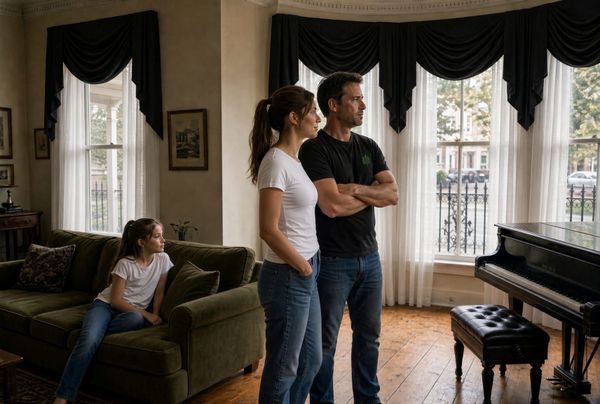
You were supposed to be back by dark.

This is the fourth post in the AFR 64-4 series. Chapter 16 was fire. Chapter 17 was the small pack — what is still on you when the main stores are gone. Chapter 18 was food. Chapter 15 is shelter. The manual puts it before the fire chapter. A night in the Whites will teach you why.
A long day does not fail in the parking lot. It fails on the way down. The weather was not the morning forecast. Somebody cannot bear weight. You are not camping. You are waiting. Wind, wet, and the ground under you will do more damage in the next few hours than the injury did.
Shelter is anything that keeps that off the body. Section 15-1 is that plain. It is not a four-season tent. On a day hike it is a lightweight shelter you actually carried, and the cord that makes it stand.
The summit does not use the valley calendar
Mount Washington is the example because people already think they know it. They do not.
Snow on the last day of June is not a campfire story. On June 30, 1988, the summit recorded 5.1 inches. That is the largest single-day June snowfall in the modern record. A typical June up there still averages a little over an inch of snow. The record June low is 13°F. From Conncord, that sounds late. On the mountain it is a line in a log.
“Unexpected” is a parking-lot word. A mountaineer packs for the elevation they are walking into, not the temperature they left in the car. If you cannot sit out a storm, a whiteout, or a night with an injury, you are not ready for a long day above treeline.
What Chapter 15 actually says
15-2 — Pick the site while you can still think
Late afternoon is the worst time to start looking. You get the leftover ground. Wet. Windy. Sloped. Under dead wood. Decide earlier. If the group is slowing, the cloud is dropping, or someone is shivering and clumsy, stop while you still have light.
The manual makes you look at four things before you build.
- Time and energy. Use what is already there. A boulder on the lee side. A tight stand of trees below treeline. A rock overhang you have checked for loose blocks. Do not spend the last of your strength on a palace.
- Weather. Temperature, wind, and whatever is falling. In the cold, get out of the wind. Do not drop into the valley floor if you can help it. Cold air pools there at night. In a gully or a dry brook bed, rain becomes water and debris. A clean stripe of brush from the top of a slope to the bottom is a path snow or rock has already used. Do not sleep in it.
- What else lives there. Standing water means insects. Game trails and waterholes mean traffic at dusk. Poison ivy does not belong in the bed. Standing dead trees and hung-up branches come down in the same wind you are hiding from.
- Terrain. Avalanche paths, scree slopes, mud. These are quieter than a thunderstorm and they still kill people.
15-3 — Four tests, then stop looking
The manual’s location tests, said for a day that broke:
- Can you stay here without getting more hurt, and can someone find you?
- Does the ground already give you protection?
- Do you have what you carried — cord, tarp or bivy, pads — or are you about to invent a shelter out of nothing?
- Can the injured person lie flat?
Natural cover first. A cave, a checked overhang, the lee of a boulder, a fallen log, a tree well in snow. Modify that. Do not start from bare ground if the mountain already built half of it.
If a fire goes in front of that shelter, it is the fire from Chapter 16. Not a canister. Not under a snow-loaded branch. Not so close that the fabric, the spilled fuel, or the wreckage catches. The opening sits about 90 degrees to the wind, not facing it. Smoke in the shelter is not warmth.
15-4 — Immediate shelter is the first shelter
An immediate shelter is the one that goes up before you are clever. The manual’s list is rafts, aircraft parts, parachute, paulin, a plastic bag, an overhang, a fallen log, a cave, a tree well.
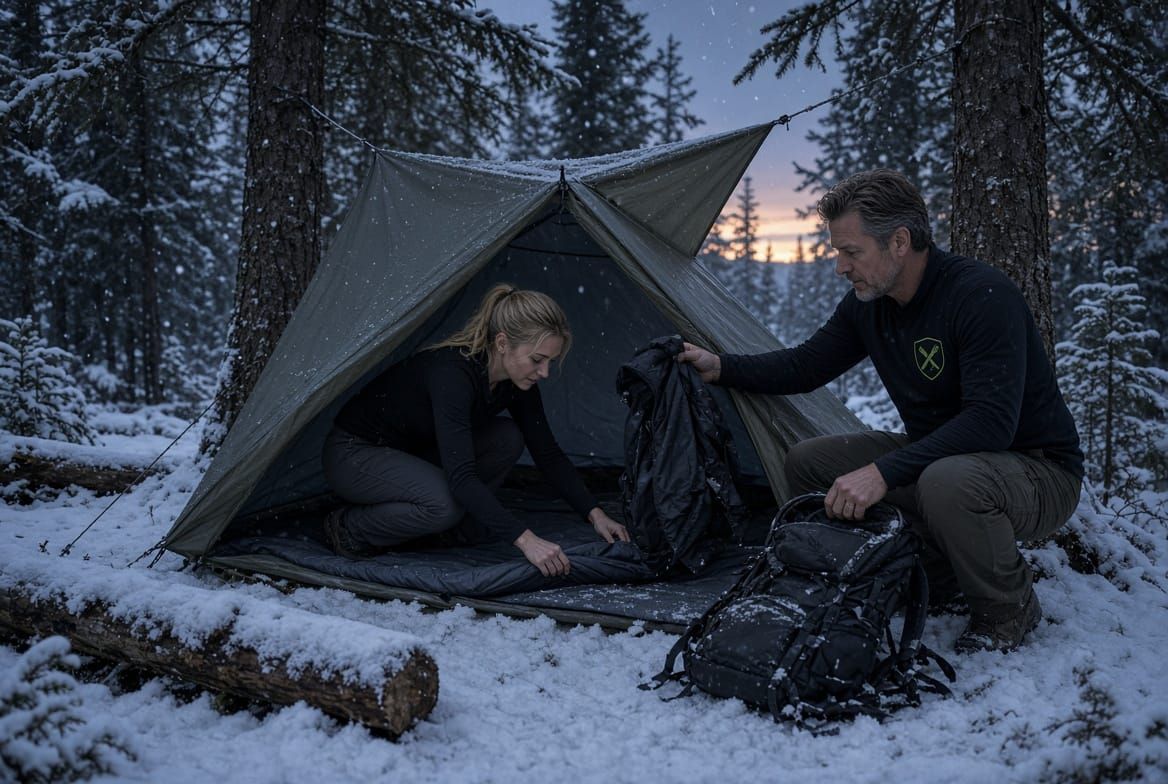
On a Presidentials day hike the translation is shorter. Get the body out of the wind in minutes. Crawl into the bivy. Pull the bothy over the group. Drop behind the boulder and hang the tarp as a wall. Pad under the injured person. Hood up. This is the move when people are already getting cold.
Exact dimensions do not matter yet. Protection does.
15-5 and 15-6 — Then you improve it
Improvised shelters take longer. The manual’s A-frame is the one that travels. It works in warm woods and, with more cover, in the cold. A shade shelter is for heat. Snow shelters and tree pits are for when snow is the material you have.
If the cover has to shed rain or snow, pitch and tightness are the whole trick. Parachute cloth is porous. So is a lot of cheap emergency plastic once it sags. Stretch it tight. Give it a steep angle, about 40 to 60 degrees, so water runs off instead of pooling. Wrinkles hold water. Do not touch the wet ceiling from the inside. Two layers beat one. The outer sheds. The inner catches the mist. The air between them holds heat.
The framework has to carry wet snow and a gust. Clean the stubs off any pole that will touch the fabric. Stake from the back toward the front, side to side, until the skin is tight. A door keeps wind and insects out. Chapter 17 already told you to keep the knife sharp and the cord where you can reach it. This is the job.
Insulate the ground before you congratulate yourself. Rock and snow pull heat faster than the air. Pack, sit pad, rope coils, extra layers. Anything between the body and the stone.
Why the cord and the lightweight shelter are the day-hike pair
The small pack from Chapter 17 is what is still on you when the truck is at the trailhead. A tent you left in camp is not shelter. A space blanket with nothing to tie it is a wet sheet.
Carry both.
The shelter. Pick one you will actually bring.
- An emergency bivy, about 4 ounces. Fastest when you are alone, hurt, or the weather is already on you. It drafts less than a blanket. It is a poor place to treat a second person, and it sweats.
- A breathable emergency bivy, about 8 ounces. Same idea. Less of a sweat box. Worth it if a night out is a real risk on your routes.
- A small tarp or emergency tent plus cord, often 8 to 16 ounces. A-frame, a lean-to on a boulder, or a low pitch over someone who cannot sit up. More skill. More room.
- A bothy bag if you travel as a group. No poles. Everyone inside, out of the wind.
The cord. Fifty to one hundred feet of 550 paracord or 3 mm accessory cord, on a hank, not a bracelet you will not unweave with numb fingers.
It is the ridgeline between trees, trekking poles, or boulders. It is the guy lines. It is the lashing for the A-frame. It closes a bivy in the wind. It anchors to a rock when stakes will not hold. It lashes a splint to a pad so you can move someone a short distance to a better site. It hangs wet layers out of the bed. It can mark the way back toward the trail.
It is not a climbing rope. Do not rappel on it.
Four knots, learned at home: bowline, clove hitch, taut-line or trucker’s hitch, and a square lash. The first time you tension a ridgeline should not be in a whiteout.
Immediate first. Fancy second. If people are getting wet, the bivy or the bothy goes on now. The neat A-frame is the improvement, not the emergency.
New Hampshire is not a different chapter
The manual assumes someone will look for you. In this state you have to make that true before you leave the lot.
Leave the plan with a person who is not on the trip. Not “I’m hiking Washington.”
- Who is going
- Trailhead, route, and turnaround
- When you start
- When you expect to be back, and the clock time that means overdue
- Who they call when you miss it
In New Hampshire that call is 911, and NH Fish and Game at (603) 271-3361. If the route changes, you tell them. A search that starts in the wrong ravine spends the hours you are losing to the cold.
Carry a way to talk that does not need a cell tower. Service in the ravines is a rumor. A satellite texting or calling device — a Garmin inReach, a ZOLEO, or the same class of two-way messenger — sends the location, tells your contact you have stopped, and reaches rescue without a walk to a bar of signal. Charge it. Test it at the kitchen table. Know the buttons with gloves on. A one-way beacon is better than a dead phone. It is not as good as a message that says which drainage you are in.
Buy the 2026 Hike Safe Card if you are not already covered. Fish and Game put it in one sentence on January 14, 2026: be prepared for the unexpected, and buy the card.
- $25 for one person. $35 for a family. Same price for residents and nonresidents.
- Good for the 2026 calendar year, through December 31.
- Online at wildnh.com/safe, or at headquarters, 11 Hazen Drive, Concord.
- It exempts the holder from repaying search-and-rescue costs when the conduct that caused the rescue was neither negligent nor reckless. It is not a pass for going up bare. A current New Hampshire hunting or fishing license, or a current boat, snowmobile, or OHRV registration, already gives the same protection.
- The money, aside from the processing fee, goes to the Search and Rescue Fund. That is training and equipment for the Conservation Officers who actually walk in.
The card does not replace the Hike Safe code. Know the route and the weather. Leave the plan. Stay together. Turn back when the weather turns or the daylight is running out. Carry what an emergency requires, not what a summit photo requires.
The card, the message, and the shelter are three different tools. The card helps pay for the rescue. The satellite tells them where. The shelter is how you are still alive when they get there.
Where it sits
Same layers as 17-2.
- On the body: knife, fire kit, a way to treat water, the whistle.
- In the small pack: bivy or tarp, the cord, a sit pad, an extra layer, hat, gloves, rain shell, headlamp, the satellite messenger, a paper map and a compass, a little food you already counted in Chapter 18.
- Left with someone at home: the route, the clock time you will be back, and the number they call. The Hike Safe Card can live in the wallet. The plan cannot live only on your phone.
If the small pack is a second pantry and a second tent, you will not grab it. Chapter 15 does not cancel that.
Practice that matches the mission
Do not only read Chapter 15.
On the next easy evening, not in a storm:
- Pitch the shelter you actually carry. Cord only. No practice stakes you will not have on the ridge.
- Time it. If it takes more than a few minutes, it is still a toy.
- Sleep on the pad, not on the ground, long enough to feel the difference.
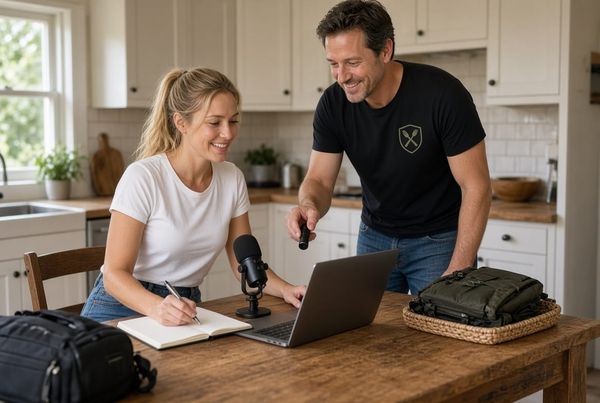
- Send a test message on the satellite device to the same person who holds your hike plan.
- Write the plan the way you would leave it: who, where, out, back, who they call.
- If you hike in New Hampshire this year and you do not already hold a license or a registration that covers you, buy the 2026 card before the next long day.
If you have never tensioned the ridgeline, the mountain is a bad classroom.
A day hike that cannot become a night is a bet. June 30, 1988, already told you how that bet goes on this mountain. Cord makes the shelter stand. The lightweight tent or bivy makes the wind stop. The plan you left, and the message you can still send, are how someone knows where to look.
Read the source. Put it in the Ready Center.
AFR 64-4 Vol I, 15 July 1985, Chapter 15 — Shelter.
https://archive.org/details/USAirForceSurvivalSchoolAFRegulation644.11985
https://archive.org/details/Afr64-4352-481Survivalmanual
2026 Hike Safe Card — NH Fish and Game, 14 January 2026